(Whole Blood/Serum/Plasma) [INTENDED USE] COVID-19 IgG/IgM Rapid Test Cassette (Whole Blood/Serum/Plasma) is a solid phase immunochromatographic assay for the rapid, qualitative and differential detection of IgG and IgM antibodies to 2019 Novel Coronavirus in human whole blood, serum or plasma. This test provides only a preliminary test result. Therefore, any reactive specimen with the COVID-19 IgG/IgM Rapid Test Cassette (Whole Blood/Serum/Plasma) must be confirmed with alternative testing method(s) and clinical findings. [INTRODUCTION] The novel coronaviruses belong to the β genus. COVID-19 is an acute respiratory infectious disease. People are generally susceptible. Currently, the patients infected by the novel coronavirus are the main source of infection; asymptomatic infected people can also be an infectious source. Based on the current epidemiological investigation, the incubation period is 1 to 14 days, mostly 3 to 7 days. The main manifestations include fever, fatigue and dry cough. Nasal congestion, runny nose, sore throat, myalgia and diarrhea are found in a few cases. [PRINCIPLE] The COVID-19 IgG/IgM Rapid Test Cassette (Whole Blood/Serum/Plasma) is a lateral flow immunochromatographic assay. The test uses anti-human IgM antibody (test line IgM) , anti-human IgG (test line IgG) and rabbit IgG (control line C) immobilised on a nitrocellulose strip. The burgundy coloured conjugate pad contains colloidal gold conjugated to recombinant COVID-19 antigens conjugated with colloid gold (COVID-19 conjugates). When a specimen followed by assay buffer is added to the sample well, IgM &/or IgG antibodies if present, will bind to COVID-19 conjugates making antigen antibodies complex. This complex migrates through nitrocellulose membrane by capillary action. When the complex meets the line of the corresponding immobilized antibody (anti-human IgM &/or anit-human IgG) the complex is trapped forming a burgundy coloured band which confirm a reactive test result. Absence of a coloured band in the test region indicates a non reactive test result. To serve as a procedural control, a coloured line will always change from blue to red in the control line region, indicating that the proper volume of specimen has been added and membrane wicking has occurred. [MATERIALS SUPPLIED] 25 Cassettes 25 Droppers/Capillary tubes 25 Desiccants 1 Buffer 1 Package insert [MATERIALS REQUIRED BUT NOT PROVIDED] 1. Specimen collection containers 2. Centrifuge (for plasma only) 3. Timer |
[STORAGE AND STABILITY] The kit can be stored at room temperature or refrigerated (2-40°C). The test device is stable through the expiration date printed on the sealed pouch. The test device must remain in the sealed pouch until use. DO NOT FREEZE. Do not use beyond the expiration date. [WARNINGS AND PRECAUTIONS] |
|||
| 1. | For professional In Vitro diagnostic use only and not for home use. Do not use after expiration date. | ||
| 2. | This package insert must be read completely before performing the test. Failure to follow the insert gives inaccurate test results. | ||
| 3. | Do not use it if the tube/pouch is damaged or broken. | ||
| 4. | Test is for single use only. Do not re-use under any circumstances. | ||
| 5. | Handle all specimens as if they contain infectious agents. Observe established precautions against microbiological hazards throughout testing and follow the standard procedures for proper disposal of specimens. | ||
| 6. | Wear protective clothing such as laboratory coats, disposable gloves and eye protection when specimens are assayed. | ||
| 7. | Humidity and temperature can adversely affect results. | ||
| 8. | Do not perform the test in a room with strong air flow, ie. electric fan or strong air-conditioning. | ||
[SPECIMEN COLLECTION] |
|||
| 1. | COVID-19 IgG/IgM Rapid Test Cassette (Whole Blood/Serum/Plasma) can be performed using either whole blood, serum or plasma. | ||
| 2. | Separate serum or plasma from blood as soon as possible to avoid hemolysis. Use only clear, non-hemolyzed specimens. | ||
| 3. | Testing should be performed immediately after specimen collection. Do not leave the specimens at room temperature for prolonged periods. Serum and plasma specimens may be stored at 2-8°C for up to 3 days. For long term storage, specimens should be kept below -20°C. Whole blood collected by venipuncture should be stored at 2-8°C if the test is to be run within 2 days of collection. Do not freeze whole blood specimens. | ||
| 4. | Bring specimens to room temperature prior to testing. Frozen specimens must be completely thawed and mixed well prior to testing. Specimens should not be frozen and thawed repeatedly. | ||
| 5. | If specimens are to be shipped, they should be packed in compliance with local regulations covering the transportation of etiologic agents. | ||
[TEST PROCEDURE] |
|||
Allow test cassette, specimen,buffer and/or controls to equilibrate to room temperature (15-30°C) prior to testing. |
|||
| 1. | Remove the test cassette from the sealed foil pouch and use it as soon as possible. Best results will be obtained if the assay is performed within one hour. | ||
| 2. | Place the test device on a clean and level surface. |
||
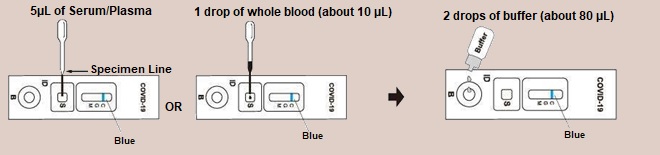
With a 5/10 µL mini plastic dropper provided: For Serum or Plasma Specimens: Draw serum/plasma specimen to exceed the specimen line as showed in the following image and then transfer drawn serum/plasma specimen into the sample well ( S ). Then add 2 drops (about 80 µL) of sample buffer to the buffer well ( B ) immediately. Avoid air bubbles. Note: Practice a few times prior to testing if you are not familiar with the mini dropper. For better precision, transfer specimen by pipette capable to deliver 5 µL of volume. For Whole Blood Specimen: Hold the 5/10 µL mini plastic dropper vertically and transfer 1 drop of whole blood (about 10 µL) to the specimen well (S) of the test device, then add 2 drops (about 80 µL) of sample buffer to the buffer well ( B ) immediately. Avoid air bubbles. |
|||
 |
|||
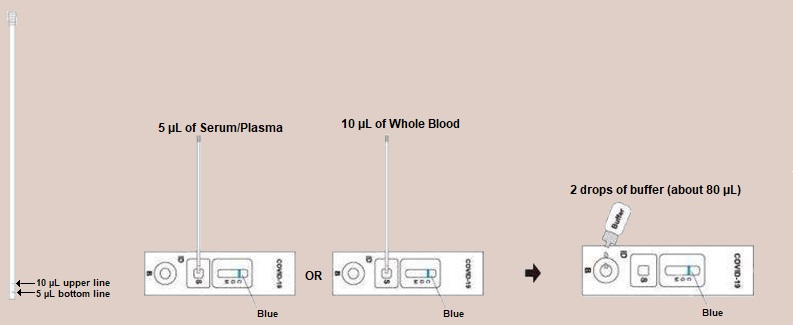
With a 5/10 µL capillary tube provided: For Serum or Plasma Specimens: Draw serum/plasma specimen to the bottom scale line as showed in the following image and then transfer drawn serum/plasma specimen into the sample well ( S ). Then add 2 drops (about 80 µL) of sample buffer to the buffer well ( B ) immediately. Avoid air bubbles. For Whole Blood Specimen: Draw whole blood specimen to the upper scale line as showed in the following image and then transfer drawn whole blood specimen into the sample well ( S ) of the test device, then add 2 drops (about 80 µL) of sample buffer to the buffer well ( B ) immediately. Avoid air bubbles. Note: Practice a few times prior to testing if you are not familiar with the 5/10 µL capillary tube. For better precision, transfer specimen by pipette capable to deliver 5 µL and 10 µL of volume. |
|||
 |
|||
| 3. | Wait for the coloured line(s) to appear. After 2 minutes, if the red colour has not moved across the test window or if blood is still present in the specimen well (S), add 1 additional drop of the sample buffer to the buffer well ( B ). | ||
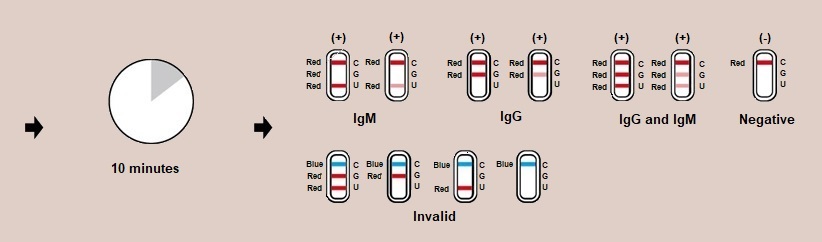
| 4. | The result should be read in 10 minutes. Positive results may be visible as
soon as 2 minutes. Do not interpret the result after 15 minutes. |
||
 |
|||
[INTERPRETATION OF RESULTS] NEGATIVE: The coloured line in the control line region (C) changes from blue to red. No line appears in the test line regions M or G. The result is negative. IgM POSITIVE: The coloured line in the control line region (C) changes from blue to red, and a coloured line appears in test line region M. The result is anti-COVID-19 IgM positive, consistent with an acute or recent COVID-19 virus infection. IgG POSITIVE: The coloured line in the control line region (C) changes from blue to red, and a coloured line appears in test line region G. The result is anti-COVID-19 IgG positive,consistent with a recent or previous COVID-19 virus infection. IgG and IgM POSITIVE: The coloured line in the control line region (C) changes from blue to red, and two coloured lines appear in test line regions M and G. The result is anti-COVID-19 IgM and IgG positive, suggesting current or recent COVID-19 virus infection. INVALID: Control line is still completely or partially blue, and fails to completely change from blue to red. Insufficient specimen volume or incorrect procedural techniques are the most likely reasons for control line failure. Review the procedure and repeat the test with a new test cassette. If the problem persists, discontinue using the test kit immediately and contact your local distributor. |
|
[QUALITY CONTROL] A procedural control is included in the test. A red line appearing in the control region (C) is the internal procedural control. It confirms sufficient specimen volume and correct procedural technique. Control standards are not supplied with this kit; however it is recommended that positive and negative controls be tested as a good laboratory practice to confirm the test procedure and to verify proper test performance. |
|
[LIMITATIONS] |
|
| 1. | Use fresh samples whenever possible. Frozen and thawed samples (especially repeatedly) contain particles that can block the membrane. This slows the flow of reagents and can lead to high background color, making the interpretation of results difficult. |
| 2. | Optimal assay performance requires strict adherence to the assay procedure described in this insert sheet. Deviations may lead to aberrant results. |
| 3. | A negative result for an individual subject indicates absence of detectable anti-COVID-19 antibodies. However, a negative test result does not preclude the possibility of exposure to or infection with COVID-19, particularly for patients who have been in contact with known infected persons or in areas with high prevalence of active infection. Follow-up testing with a molecular diagnostic test is necessary to rule out infection in these individuals. |
| 4. | A negative result can occur if the quantity of the anti-COVID-19 antibodies present in the specimen is below the detection limits of the assay, or the virus has undergone minor amino acid mutation(s) in the epitope recognized by the antibody utilized in the test, or the antibodies that are detected are not present during the stage of disease in which a sample is collected. |
| 5. | Some specimens containing unusually high titer of heterophile antibodies or rheumatoid factor may affect expected results. |
| 6. | False positive results may occur due to cross-reacting antibodies from previous infections, such as other coronaviruses, or from other causes. |
| 7. | Samples with positive results should be confirmed with alternative testing method(s) and clinical findings before a diagnostic determination is made. |
| 8. | If symptoms persist and the result from the COVID-19 IgG/IgM Rapid Test Cassette (Whole Blood/Serum/Plasma) performance section is negative, it is recommended to re-sample the patient a few days later or test with an alternative test device. |
| 9. | Results from antibody testing should not be used as the sole basis to diagnose or exclude COVID-19 infection. As with all diagnostic tests, a definitive clinical diagnosis should not be based on the result of a single test, but should only be made by the physician after all clinical and laboratory findings have been evaluated. |
[PERFORMANCE CHARACTERISTICS] 1. Clinical Performance The COVID-19 IgG/IgM Rapid Test Cassette (Whole Blood/Serum/Plasma) has been evaluated with the 938 serum or plasma samples obtained from patients exhibiting pneumonia or respiratory symptoms. The results were compared to clinical diagnosis (based on RT-PCR, Chest Computed Tomography and/or clinical signs etc.). |
 |
Relative sensitivity: 90.11% (319/354) Relative specificity: 98.46% (575/584) Accuracy: 95.31% (894/938) |
|
[REFERENCE] |
|
| 1. | Weiss SR, Leibowitz JL. Coronavirus pathogenesis. Adv Virus Res 2011; 81: 85-164. |
| 2. | Masters PS, Perlman S. Coronaviridae. In: Knipe DM, Howley PM, eds. Fields virology. 6th ed. Lippincott Williams & Wilkins, 2013: 825-58. |
[INDEX OF SYMBOLS] 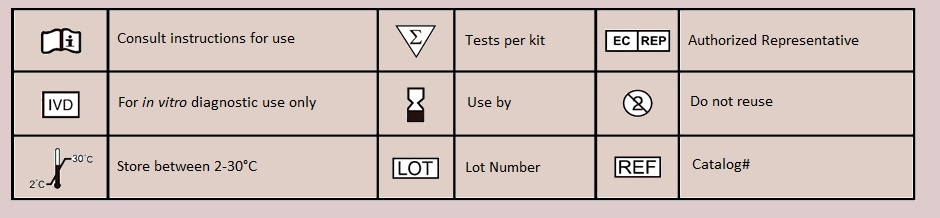 |
|
 |
ICT INTERNATIONAL Address: 271 De Goede Hoop Estate Noordhoek Cape Town Tel: +27 82 441 1922 Email: russell@ictdiagnostics.co.za Website: www.ictdiagnostics.co.za Ref: COV-19 IG 25 T Revision Date: 2020-06-12 |