Combo Rapid Test Cassette (Swab) Package Insert GC/CHLAM English |
| A rapid test for the qualitative detection of Gonorrhea and Chlamydia antigen
in female cervical swab and male urethral swab specimens. For professional in vitro diagnostic use only. |
| [INTENDED USE] The Gonorrhea and Chlamydia Combo Rapid Test Cassette is a rapid chromatographic immunoassay for the qualitative detection of Neisseria gonorrhoeae and Chlamydia trachomatis in female cervical swab and male urethral swab specimens to aid in the diagnosis of Gonorrhea and Chlamydia infection. |
| [SUMMARY] Gonorrhea and Chlamydia are very common STDs accounting for nearly 45% of all STD cases. A combination testing of the two helps in simultaneous testing for the two most common causative agents of STDs. Gonorrhea is a sexually transmitted disease caused by the bacterium Neisseria gonorrhoeae. It is most frequently transmitted during sexual intercourse, including vaginal, oral and anal sex. It can infect the throat, producing a severe sore throat, can infect the anus and rectum, producing a condition called proctitis. In females, it can infect the vagina, causing irritation with drainage (vaginitis). Infection of the urethra may cause urethritis with burning, painful urination, and a discharge. When women have symptoms, they often note vaginal discharge, increased urinary frequency, and urinary discomfort. Spread of the organism to the fallopian tubes and abdomen may cause severe lower-abdominal pain and fever. The average incubation for Gonorrhea is approximately 2 to 5 days following sexual contact with an infected partner. However, symptoms may appear as late as 2 weeks. A preliminary diagnosis of Gonorrhea can be made at the time of examination.1 In women, Gonorrhea is a common cause of pelvic inflammatory disease (PID). PID can lead to internal abscesses and long-lasting, chronic pelvic pain. PID can damage the fallopian tubes enough to cause infertility or increase the risk of ectopic pregnancy.2 Chlamydia trachomatis is the most common cause of sexually transmitted venereal infection in the world. Composed of elementary bodies (the infectious form) and reticulate or inclusions bodies (the replicating form), Chlamydia trachomatis has both a high prevalence and asymptomatic carriage rate, with frequent serious complications in both women and neonates. Complications of Chlamydia infection in women include cervicitis, urethritis, endometritis, PID and increased incidence of ectopic pregnancy and infertility.3 Vertical transmission of the disease during parturition from mother to neonate can result in inclusion conjunctivitis pneumonia. In men, complications of Chlamydia infection include urethritis and epididymitis. Approximately 70% of women with endocervical infections and up to 50% of men with urethral infections are asymptomatic. The Gonorrhea and Chlamydia Combo Rapid Test Cassette (Swab) is a rapid test to qualitatively detect the Gonorrhea and Chlamydia antigen from female cervical swab and male urethral swab specimens. |
| [PRINCIPLE] The Gonorrhea and Chlamydia Combo Rapid Test Cassette (Swab) is a qualitative, lateral flow immunoassay for the detection of Neisseria gonorrhoeae and Chlamydia trachomatis in female cervical and male urethral swab specimens. In the test, antibodies specific to the Gonorrhea and Chlamydia antigen is coated on the test line region of the test. During testing, the extracted antigen solution reacts with antibodies against Gonorrhea and Chlamydia antigens that is coated onto particles. The mixture migrates up to react with the antibodies against Gonorrhea and Chlamydia antigens on the membrane and generates a color line in the test region. The presence of this colored line in the test line region (T) of gonorrhea indicates a positive result for gonorrhea and the presence of a colored line in the test line region (T) of chlamydia indicates a positive result for chlamydia. The absence of a colored line in either test line region for gonorrhea or test line region for chlamydia indicates a negative result for the respective organism. To serve as a procedural control, a colored line will always appear in the control line region, indicating that proper volume of specimen has been added and membrane wicking has occurred. |
| [REAGENTS] The test contains Gonorrhea and Chlamydia antibodies coated particles and Gonorrhea and Chlamydia antibodies coated on the membrane. |
| [PRECAUTIONS] | |
| 1. | For professional in vitro diagnostic use only. Do not use after the expiration date. |
| 2. | Do not eat, drink or smoke in the area where the specimens and kits are handled. |
| 3. | Handle all specimens as if they contain infectious agents. Observe established precautions against microbiological hazards throughout the procedure and follow the standard procedures for proper disposal of specimens. |
| 4. | Wear protective clothing such as laboratory coats, disposable gloves and eye protection when specimens are assayed. |
| 5. | The used test should be discarded according to local regulations. |
| 6. | Humidity and temperature can adversely affect results. |
| 7. | Do not use test if pouch is damaged. |
| [STORAGE AND STABILITY] | |
| Store as packaged in the sealed pouch at room temperature or refrigerated
(2-30°C). The test isstable through the expiration date printed on the sealed pouch. The test must remain in the sealed pouch until use. DO NOT
FREEZE. Do not use beyond the expiration date.
|
| [SPECIMEN COLLECTION AND PREPARATION] | |||
| • | The Gonorrhea and Chlamydia Combo Rapid Test Cassette (Swab) can be performed usingfemale cervical swab and male urethral swab specimens. | ||
| • | The quality of specimens obtained is of extreme importance. Detection of Gonorrhea and Chlamydia antigens requires a vigorous and thorough collection technique that provides cellular material rather than just body fluids. | ||
| • | To collect Female Cervical Swab Specimen: | ||
| * | Use the swab provided in the kit. Alternatively, any plastic-shaft swab may be use. | ||
| * | Before specimen collection, remove excess mucus from the endocervical area with a cotton ball and discard. The swab should be inserted into the endocervical canal, past the squamocolumnar junction until most of the tip is no longer visible. This will permit acquisition of columnar or cuboidal epithelial cells, which are the main reservoir of the Chlamydia organism. Firmly rotate the swab 360° in one direction (clockwise or counterclockwise), let stand for 15 seconds, then withdraw the swab. Avoid contamination from exocervical or vaginal cells. Do not use 0.9% sodium chloride to treat swabs before collection specimens. | ||
| * | If the test is to be conducted immediately, put the swab into the extraction tube. | ||
| • | To collect Male Urethral Swab Specimens: | ||
| * | Standard plastic-or wire-shaft sterile swabs should be used for urethral specimen collection. Instruct patients not to urinate for at least 1 hour period to specimen collection. | ||
| * | Insert the swab into the urethral about 2-4 cm, rotate the swab 360° in one direction (clockwise or counterclockwise), let stand for 10 seconds, then withdraw. Do not use 0.9% sodium chloride to treat swabs before collection swab. | ||
| * | If the test is to be conducted immediately, put the swab into the extraction tube. | ||
| • | It is recommended that specimens be processed as soon as possible after collection. If immediately testing is not possible, the patient swab specimens should be placed in a dry transport tube for storage or transport. The swab may be stored for 4-6 hours at room temperature (15-30°C) or refrigerated (2-8°C) for 24 hours. Do not freeze. All specimens should be allowed to reach the room temperature (15-30°C) before testing. | ||
| [MATERIALS] | |
| Materials provided | |
| • Test Cassettes • Extraction Tubes • Extraction Reagent 1 (0.2M NaOH) • Sterile Female Cervical Swabs • Extraction Reagent 2 (0.2 M HCl) • Workstation • Dropper Tips • Package insert |
|
| Materials required but not provided | |
| • Sterile Male Urethral Swabs • Timer |
| [DIRECTIONS FOR USE] |
|
| Allow the test, reagents, swab specimen, and/or controls to reach room 3 temperature (15-30℃) prior to testing. | |
| 1. | Remove the test cassette from the foil pouch and use it within one hour. Best results will be obtained if the test is performed immediately after opening the foil pouch. |
| 2. | Extract the Chlamydia antigen according to the specimen type. |
| • | For Female Cervical or Male Urethral Swab Specimen: | ||
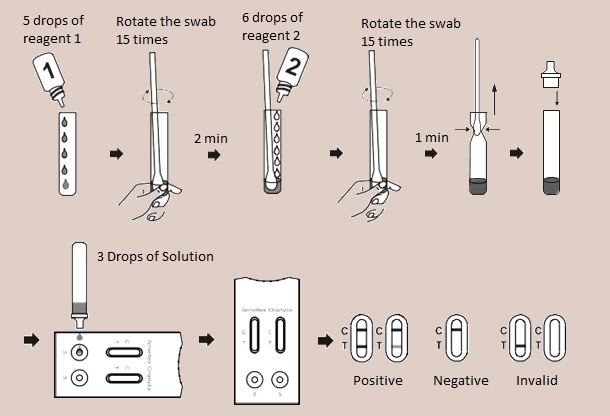
| ⚬ | Hold the reagent 1 bottle vertically and add 5 drops of reagent 1 (approx. 300ul) to the extraction tube. Reagent 1 is colorless. Immediately insert the swab, compress the bottom of tube and rotate swab 15 times. Let stand for 2 minutes. | ||
| ⚬ | Hold the reagent 2 bottle vertically add 6 drops of reagent 2 (approx. 250ul) to the extraction tube. The solution would turn turbid. Compress the bottle of tube and rotate the swab 15 times until the solution turn clear with a slight green or blue tint. If the swab is bloody, the color will turn yellow or brown. Let stand 1 minute. | ||
| ⚬ | Press the swab against the side of tube and withdraw the swab while squeezing the tube. Keep as much liquid in the tube as possible. Fit the dropper tip on top of extraction tube. | ||
| 3. | Place the test cassette on a clean and level surface. Add 3 full drops of the
extracted solution (approx. 100ul) to each specimen wells of the test cassette, then start the timer. Avoid trapping air bubbles in the specimen
well. |
| 4. | Wait for the colored line(s) to appear. Read the result at 10 minutes; do not
interpret the result after 20 minutes. |
| Note: It is recommended to use the buffer within 6 months
after opening the vial. |
|
 |
|
| [INTERPRETATION OF RESULTS] |
|
| POSITIVE for Gonorrhea:* Two colored lines appear in the Gonorrhea
window. One line should be in the control line region (C) and another line should be in the test line region (T) in the Gonorrhea window. POSITIVE for Chlamydia:* Two colored lines appear in the Chlamydia window. One line should be in the control line region (C) and another line should be in the test line region (T) in the Chlamydia window. POSITIVE for Gonorrhea and Chlamydia:* Two colored lines appear in both windows. One line should be in the control line region (C) and another line should be in the test line region (T) in both of Gonorrhea and Chlamydia windows. *NOTE: The shade of color in the test line region (T) may vary, but it should be considered positive whenever there is even a faint colored line. NEGATIVE for Chlamydia and Gonorrhea: Only colored lines appear in the control line regions (C) of both Gonorrhea and Chlamydia windows. No apparent colored line appears in the test line region (T) of either Gonorrhea or Chlamydia window. INVALID: No line appears in the control line region (C). If this occurs, read the directions again and repeat the test with a new test. If the result is still invalid, stop using the test kit immediately and contact your local distributor. |
|
| [QUALITY CONTROL] Internal procedural controls are included in the test individually for both two sections. Two colored lines appearing in control line regions (C) for both two sections are the internal procedural controls. It confirms sufficient specimen volume and correct procedural technique. Control standards are not supplied with this kit; however, it is recommended that positive and negative controls be tested as good laboratory practice to confirm the test procedure and to verify proper test performance. |
|
| [LIMITATIONS] |
|
| 1. | The Gonorrhea and Chlamydia Combo Rapid Test Cassette (Swab) is for in vitro diagnostic use only. This test should be used for the detection of Gonorrhea and/or Chlamydia antigen from female cervical swab and male urethral swab specimens. Neither the quantitative value nor the rate of increase in Gonorrhea or Chlamydia antigen concentration can be determined by this qualitative test. |
| 2. | This test will only indicate the presence of Gonorrhea and/or Chlamydia antigen in specimens from both viable and non-viable Neisseria gonorrhoeae and Chlamydia trachomatis. Performance with specimens other than female cervical swabs and male urethral swabs has not been assessed. |
| 3. | Detection of Gonorrhea and Chlamydia is dependent on the number of organisms present in the specimen. This can be affected by specimen collection methods and patient factors such as age, history of Sexually Transmitted Diseases (STDs), presence of symptoms, etc. The minimum detection level of this test may vary according to serovar. Therefore, the test results should be interpreted in conjunction with other laboratory and clinical data available to the physician. |
| 4. | Therapeutic failure or success cannot be determined as antigen may persist following appropriate antimicrobial therapy. |
| 5. | Excessive blood on the swab may cause false positive results. |
| [EXPECTED VALUES] | |
| Gonorrhea is a common adult disease around the world. With 351,852 Gonorrhea
cases reported in 2002 (125.0 cases per 100,000 people), a significant proportion of those with infection are asymptomatic and many victims will not
go to see the doctor, making the prevalence higher than the report rate in fact. A significant number of women may be asymptomatic and may be at
risk for chronic or disseminated infection.4 In the case of pregnant women, there is a potential risk of passage of Gonorrhea to the
newborn.5 For women attending STD clinics and other high-risk populations, the prevalence of Chlamydia infection has been repeated to between 20% and 30%. In a low-risk population such as those patients attending obstetrics and gynecology clinics, the prevalence is approximately 5% or less. Reports show that for men attending STD clinics, the prevalence of Chlamydia infection is approximately 8% in asymptomatic men and 11% in symptomatic men. 1,2 Normal carriage rates of Chlamydia in asymptomatic men are less than 5%.3 |
|
| [PERFORMANCE CHARACTERISTICS] Gonorrhea:  |
| Relative Sensitivity: 94.4% (95%CI*: 86.2%-98.4%) Relative Specificity: 96.9% (95%CI*: 91.3%-99.4%) Overall Accuracy: 95.9% (95%CI*: 91.7%-98.3%) |
*Confidence Interval |
 |
| Relative Sensitivity: 91.6% (95%CI*: 84.6%-96.1%) Relative Specificity: 97.1% (95%CI*: 91.7%-99.4%) Overall Accuracy: 94.3% (95%CI*: 90.2%-97.0%) |
*Confidence Interval |
 |
| Relative Sensitivity: 93.3% (95%CI*: 81.7%-98.6%) Relative Specificity: 96.9% (95%CI*: 91.3%-99.4%) Overall Accuracy: 96.6% (95%CI*: 93.1%-98.6%) |
*Confidence Interval |
 |
| Relative Sensitivity: 86.2% (95%CI*: 74.6%-93.9%) Relative Specificity: 95.8% (95%CI*: 90.5%-98.6%) Overall Accuracy: 92.7% (95%CI*: 87.8%-96.1%) |
*Confidence Interval |
Intra/Inter-assay |
||
| Acinetobacter calcoaceticus Acinetobacter spp Enterococcus faecalis Enterococcus faecium Staphylococcus aureus Klebsiella pneumoniae |
Pseudomona aeruginosa Neisseria meningitides Salmonella choleraesius Candida albicans Proteus vulgaris Gardnerella vaginalis |
Proteus mirabilis Neisseria gonnorhea Group B/C Streptococcus Hemophilus influenzae Branhamella catarrhalis |
[BIBLIOGRAPHY] |
|
| 1. | Knapp, J.S. et al. Neisseria gonorrhoeae. Manual of Clinical Microbiology, Sixth Edition, ASMPress, Washington DC., 324-325 (1995). |
| 2. | Centers for Disease Control and Prevention. Sexually Transmitted Diseases Treatment Guidelines 2002. Morbidity and Mortality Weekly Report (2002), 51(RR-6) |
| 3. | Sanders J.W. et al Evaluation of an Enzyme Immunoassay for Detection of Chlamydia trachmatis in Urine of Asymptomatic Men. J.Clinical Microbiology, 32,24-27, (1994). |
| 4. | Summary of the Notifiable Diseases, United States, 1998, Morbidity and Mortality Weekly Report (1999), 47(53): 1-93. |
| 5. | National Institute of Allergy and Infectious Diseases, National Institute of Health, US Department of Health and Human Services, NIAID Fact Sheet on Gonorrhea, October 2004. |
| 6. | Jaschek, G. et al Direct Detection of Chlamydia trachomatis in Urine Specimens from Symptomatic and Asymptomatic Men by Using a Rapid Polymerase Chain Reaction Assay. J. Clinical Microbiology, 31,1209-1212, (1993). |
| 7. | Schachter, J Sexually transmitted Chlamydia trachomatis infection. Postgraduate Medicine, 72, 60-69, (1982). |
 |
|
ICT INTERNATIONAL 271 DE GOEDE HOOP ESTATE VILLAGE LANE NOORDHOEK. SOUTH AFRICA TEL: +27 82 441 1922 EMAIL: russell@ictdiagnostics.co.za www.ictdiagnostics.co.za |
|
Number: 145777201 Effective date: 2023-08-30 |
|