Malaria Pf/PAN Antigen RDT (HRPII/pLDH) ML03 (25 Tests) for in vitro diagnostic usage only |
| [INTENDED USE] The qualitative detection of Plasmodium falciparum (P.f.), Plasmodium vivax (P.v.), Plasmodium malariae (P.m.) and Plasmodium ovale (P.o.) antigens in whole blood (1). For the differential diagnosis of Malaria. Using an in vitro immunochromatographic assay. |
| [PRINCIPLE OF THE TEST] Two capture monoclorial antibodies (anti HRPII for P.f. and anti pLDH for PAN) are immobilized on the nitrocellulose strip. The red blood cells are lysed releasing plasmodium specific antigens which bind selectively to these antibodies as the blood is wicked up the strip. The signal reagent is coated with specific antibodies which bind with the antibody-reagent complexes so formed, producing a red line. The presence of an upper red line (the procedural control line) demonstrates the test has been performed correctly(2). |
| [SPECIMEN COLLECTION] Use the collection device provided to collect 5µl of capillary blood, or venous blood collected into EDTA tubes. |
| * | To obtain capillary blood via puncture of a finger, heel or other appropriate site, cleanse the area with a sterile swab and dry with a sterile pad. Use a lancet to puncture the skin and collect the blood using the collective device. Use the blood immediately. |
| * | Collect venous blood, by the standard venipuncture procedure, into an EDTA tube. If the test cannot be performed immediately, the blood may be stored for up to three days at 2°C - 8°C. |
| [PRECAUTIONS AND WARNINGS] | |
| • | Optimal results will be obtained by strict adherence to this protocol. Reagents must be added carefully to maintain precision and accuracy. Treat used cassettes as biohazardous. Do not reuse cassettes. |
| • | Biological contamination of dispensing equipment, containers or reagents can lead to false results. Observe established precautions against micorbiological and serological hazards in specimen handling, disposal and throughout all procedures. |
| • | Do not use kits beyond their expiration date. Keep storage boxes dry. |
| • | Store kits at 4°C - 40°C. DO NOT FREEZE. |
| • | Buffer contains sodium azide as a preservative. Sodium azide is toxic and should, therefore, be handled carefully, avoiding ingestion or skin contact. |
| • | Do not mix reagents from different kit lots. |
| • | Do not use if damaged. |
| • | Do not use if dessicant colour has reached saturation. |
| [LIMITATIONS OF PROCEDURE] | |
| • | A negative test result does not exclude infection with malaria, particulary at low levels of parasitemia. When indicated, perform the reference method (microscopical examination of thick and thin blood films). |
| • | Certain HRPII mutations may not be picked-up (false negative result). |
| • | This test has not been evaluated for monitoring treatment of malaria. Malaria antigens can still be detected for serveral days after elimination of the parasite by antimalarial treatment. This is especially the case for HRPII. |
| • | Patients with rheumatoid factors, with chronic viral infections (such as hepatitis B or C) or parasitic infections (such as schistosomiasis and trypanosomiasis) may have false positive results. |
| • | Lipaemic and icteric samples can impair the results. |
| • | The pan species test line is capable of detecting all four malaria species. However, there is a low sensitivity for detecting malaria caused by non-falciparum,in particular P. ovale and P. malariae. |
| • | The internal control (control line) only validates the migration of the test. It does not guarantee that the correct sample was used, that the sample was applied correctly or that the sample was correctly stored. |
| [KIT CONTENTS] | |
| Materials provided • Individually packaged cassettes • 5µl collection device (for blood collection) • Buffer bottle • Package insert • Lancets • Sterile swab |
|
| Materials required but not provided | |
| • Timer • Biohazard Container • Gloves |
| [MALARIA TEST PROCEDURE] |
|
| Prior to use, open the foil bag to be used, exposing the cassette. Ensure that all components are at room temperature. Select the finger for puncture, usually the side of the third or fourth finger. Clean with antiseptic and allow to air dry. Puncture the finger with a sterile lancet. Blood will well to the surface. Redo procedure on another finger is necessary. |
| 1. | Touch the collection device supplied to the blood drop and allow the
blood to fill up the cup.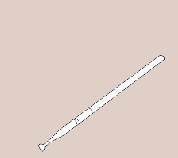 |
3. | Place 5 drops of the reaction buffer into the large base well.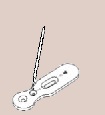 |
|
| 2. | Transfer blood to the test cassette by gently touching the filled
cup into the small sample well. |
4. | Allow the reaction to proceed for 15-30 minutes.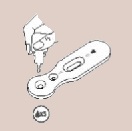
| |
| 5. | Read the result and dispose of the cassette. |
| [INTERPRETATION OF RESULTS] |
|
Invalid: Either no lines are observable or test line
without a control line. Improper test procedure was carried our or reagents have deteriorated. Re-test.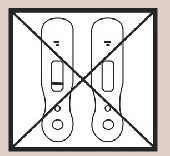 |
|
| P.f. Positive The middle and top (control) lines, or
all three lines are evident. All three lines may also show in a mixed infection. Non P.f. Positive: The bottom and top (control) lines are evident. 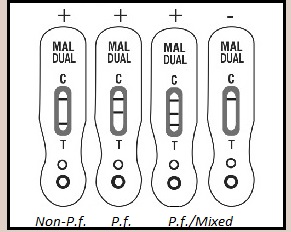 |
|
| Negative The control line is present but not either
test line, demonstrating the test was performed correctly but no malarial antigens are present. |
| [REFERENCES] |
|
| 1. | Wilson, M. (2012). Malaria Rapid Diagnostic Tests. Clin Infect Dis (2012) 54 (11): 1637-1641 |
| 2. | Arai, M. Ishii, A. Matsuoka, H. (2004). Laboratory evaluation of the ict
malaria P.f./P.v. immunochromatographic test for detecting the panmalarial antigen using a rodent malaria model. Am J Trop Med Hyg. 2004 Feb;
70(2):139-43 http://www.plosone.org/article/info%3Adoi%2F10.1371%2Fjournalpone.0008091 |
| 3. | Gillet P, Scheirlinck A, Stokx J, De Weggeleire A, Chauque H,
Canhanga O, Tadeu B, Mosse C, Tiago A, Mabunda S, Bruggeman C, Bottieau E, Jacobs J: Prozone in malaria rapid diagnostics tests: how many cases are missed? Malar J2011, 10:166. 9:215 http://www.malariajournal.com/content/10/1/166 |
| 4. | Gillet P, Mori M, Van Den Ende J, Van Esbroeck M, Jacobs J: Malaria
rapid diagnostic tests causes false-positive results. Malar J 2010, 9:215 http://www.malariajournal.com/content/9/1/215 |
| 5. | Maltha J, Gillet P, Cnops L, Van Den Ende J, Van Esbroeck M,
Jacobs J: Malaria rapid diagnostic tests: Plasmodium Falciparum infections with high parasite densities may generate false positive
Plasmodium vivax pLDH lines.
Malar J2010, 9:198 http://www.malariajournal.com/content/9/1/198 |
| 6. | Maltha J, Gillet P, Jacobs J. REVIEW: Malaria rapid diagnostic
tests in endemic settings. Clin Microbial Infect 2013; 19: 399-407.
Malar J2010, 9:198 http://onlinelibrary.wiley.com/doi/10.1111/1469-0691.12151/pdf |
| [SYMBOL KEY] Only the internationally recognized symbols in use: 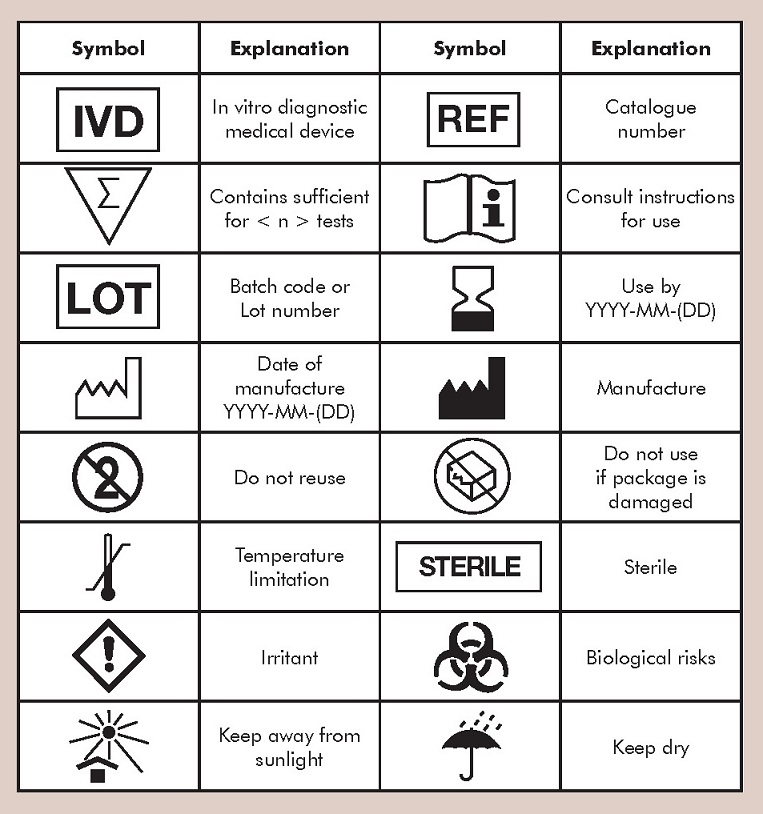 |
|
| [STORAGE CONDITIONS] |
|
| Kits stored between 4 - 40°C will have a shelf
life of 24 months after manufacture. Do not freeze. |
|
| [EXPECTED RESULTS] Shown below are 2 comparative results to blood samples, previously evaluated with microscopy based on 200 Parasites/ml and an *International Laboratory evaluated against PCR. 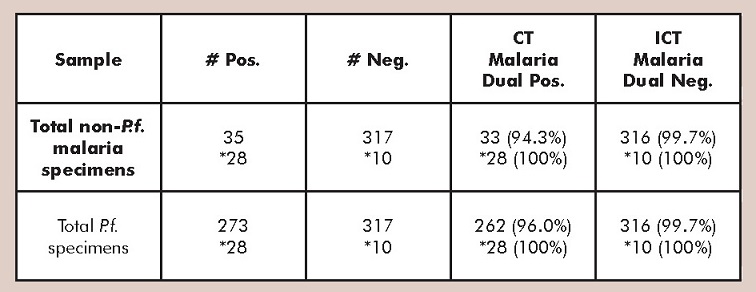 |
|
| Sensitivity (Non-P.f. malaria): 61/63 (98.8%) Sensitivity (P.f. Malaria): 290/301 (96.3%) Specificity: 326/327 (99.7%) |
|
| [CONTACT INFORMATION] ICT INTERNATIONAL 271 De Goede Hoop Estate Noordhoek, Cape Town South Africa Technical Support Tel: + 27 82 441 1922 Email :russell@ictdiagnostics.co.za www.ictdiagnostics.co.za Manufactured under: EN ISO 13485:2012 Effective date: 2020-04-13 |
|
| [ORDERING INFORMATION] Ref: ML03 25 TEST KIT |
|
| Rev. April 2015 Code: IPI-ML03E-SC |