Rapid test for the detection of HIV 1/2 in human blood, serum or plasma |
HIV25T |
| INTENDED USE The ICT HIV 1/2 device is a rapid visual immunoassay for the qualitative detection of HIV-1 and 2. It is intended for professional use to accurately diagnose HIV in human whole blood, serum or plasma. HIV (human immunodeficiency virus) is a pathogen causing AIDS (aquired immunodeficiency syndrome). HIV/AIDS is characterized by changes in the amount of T-cell lymphocytes. The virus, in infected individuals, causes a depletion of the T-helper cells, which are a sub-population of T-cells. This leaves patients susceptible to severe opportunistic infections and malignant neoplasias. The presence of the virus itself causes the immune system to produce antibodies, which can be detected by the ICT HIV 1/2 test kit. PRINCIPLE OF THE TEST The ICT HIV 1/2 device (whole blood, serum or plasma) detects HIV 1/2 through visual interpretation of color development on the membrane. Capture antigens (GP41 and GP36) are immobilized on the nitrocellulose membrane. The red blood cells are held back by the blood filtration pad releasing serum which bind selectively to these antigens as the serum is wicked up the strip. The colloidal gold signal reagent is coated with specific HIV antigens which bind with the antibody-antigen complexes formed on the membrane, producing a red line. Presence of colored bands at the test line region indicate a positive result, while their absence indicates a negative result. The presence of an upper red line ( the procedural control line) demonstrates the test has been performed correctly. REAGENTS AND MATERIAL PROVIDED IN THE KIT 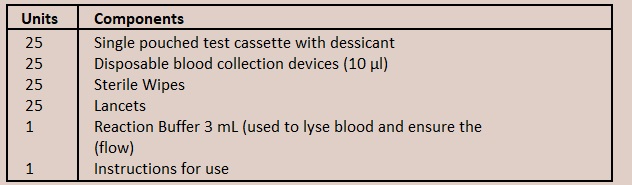 Timer required but not provided STORAGE CONDITIONS AND SHELF LIFE The following indications must be respected to ensure test performance: |
| 1. | Store kits at room temperature between 4 and 40°C. |
| 2. | Store in a dry place, humidity can affect test performance. |
| 3. | The test devices must remain pouched until usage. |
| 4. | The kits will have a shelf-life of 24 months after manufacturing. |
| 5. | Verify the expiration date printed on the kits and pouches. |
| 6. | Kits should not be frozen |
| PRECAUTIONS AND WARNINGS |
|
| 1. | For in vitro diagnostic use only. |
| 2. | All tests are for single use; do not re-use. |
| 3. | Follow the test procedure precisely, results interpretation and precautions in order to get accurate results. |
| 4. | Do not open the sealed pouch, unless ready to conduct the assay. |
| 5. | Verify the expiration date, do not use expired tests. |
| 6. | Do not mix reagents and components of different lots. |
| 7. | Do not use the test if pouch is damaged or seal is broken. |
| 8. | Do not eat, drink or smoke while handling specimens and test devices. |
| 9. | Wear protective gloves and eye protection while handling specimens. |
| 10. | Respect standard procedures to dispose specimens and potentially contaminated material, in biohazard container. |
| 11. | ICT HIV 1/2 does not present any risk to the user if used as recommended. |
SPECIMEN COLLECTION AND STORAGE Collection by Venipuncture |
|
| 1. | Collect the whole blood into the collection tube (containing EDTA, citrate, or heparin) by venipuncture. |
| 2. | If specimens are not immediately tested, they should be refrigerated at 2 - 8°C. For storage periods greater than three days, freezing is recommended. They should be brought to room temperature prior to use. Using the specimen in the long-term keeping more than three days can cause non-specific reactions. |
| 3. | When storage at 2 - 8°C, the whole blood sample should be used within three days. |
Collection using a Lancet |
|
| 1. | Clean area to be lanced with an alcohol swab. |
| 2. | Squeeze the end of the fingertip and pierce with a sterile lancet. |
| 3. | Wipe away the first drop of blood with sterile gauze or cotton. |
| 4. | Take a sample pipette provided, and while gently squeezing the tube, immerse the open end in the blood drop and then gently release the pressure to draw blood into the sample pipette up to the second line (10 µL). |
TEST PROCEDURE |
|
| Prior to use, allow the test in the foil bag to reach
room temperature. Open the foil bag to be used, only prior to conducting the test, exposing the cassette. Select the finger for puncture, usually the side of the third or fourth finger. Clean with antiseptic and allow to air dry. | 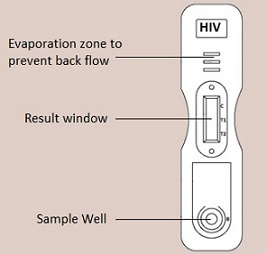 |
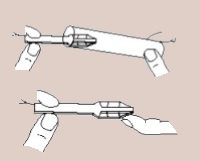
Puncture the finger with a sterile lancet. Blood will well to the surface, re-do procedure on another finger if necessary. Touch the collection device supplied to the blood spot and allow the blood to fill up to the second (10 µL) line. |
 |
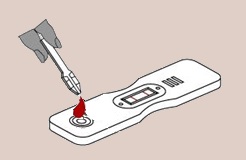
Step 1 Transfer blood/serum/plasma (to the test cassette by gently touching the nozzle to the sample well. |
 |
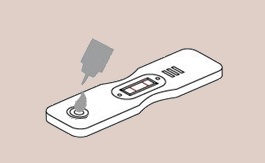
Step 2 Place 5 drops of the reaction buffer into the sample well. |
 |
Step 3 Allow the reaction to proceed for 15 minutes. Read the result and dispose of the cassette. |
 |
Interpretation of Results |
|
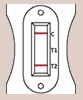
| Invalid: Either no lines are observable or either test line without a control line. Improper test procedure was carried out or reagents have deteriorated. Re-test. |
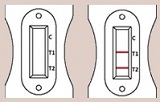 |
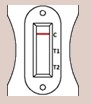
Negative: The control line is present but not either test line, demonstrating the test was performed correctly but no HIV antibodies are present. |
 |
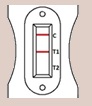
HIV-1 Positive: The middle (T1) and top (control; C) lines are evident. All three lines may also show in a mixed infection. |
 |
HIV-2 Positive: The bottom and top (control) lines are evident. |
 |
| Limitations of the Test |
|
| 1. | The ICT HIV 1/2/O test is for professional in vitro diagnostic use. It is intended to be used for the qualitative detection of HIV 1 and 2 specific antibodies. |
| 2. | If the test result is negative and clinical symptoms persist, additional testing using other clinical methods is recommended. A negative result does not at any time rule out the existence of HIV antibodies in blood, because the antigens may be absent or below the minimum detection level of the test. Consideration should also be taking into the fact that the immune response can take up to 3 months to develop antibodies which is detected in HIV tests. If the patient is uncertain as to the times of potential exposure to HIV infection, then another test should be taken in 3 months' time. |
| 3. | Like with all diagnostic tests, a confirmed diagnosis should only be made by a physician after all clinical and laboratory findings have been evaluated. |
| 4. | Definitive clinical diagnosis should not be made until the physician has evaluated the result in combination with other clinical and laboratory findings. |
Internal Quality Control The ICT HIV 1/2 immunoassay includes a control line which is used for procedural control. It should always appear confirming the test procedure has accurately performed. |
|
Symbols |
|
 |
For in-vitro diagnostic use only |  |
For single use only |
 |
Content |  |
Expiry Date |
 |
Lot Number |  |
Storage Temperature |
 ICT INTERNATIONAL 271 De Goede Hoop Estate Village Lane Noordhoek Cape Town Tel: +27 82 441 1922 www.ictdiagnostics.co.za russell@ictdiagnostics.co.za |
|||