(Whole Blood/Serum/Plasma) Package Insert REF LEP01 For professional in vitro diagnostic use only. INTENDED USE The Leptospira IgG/IgM Rapid Test Cassette (Whole Blood/Serum/Plasma) is a rapid chromatographic immunoassay for the qualitative detection of IgG and IgM antibodies to Leptospira interrogans in human's whole blood, serum or plasma. SUMMARY Leptospirosis occurs worldwide and is a common mild to severe health problem for humans and animals, particularly in area with a hot and humid climate. The natural reservoirs for leptospirosis are rodents as well as a large variety of domesticated mammals. Human infection is caused by Leptospira interrogans, the pathogenic member of the genus of Leprospira1,2. The infection is spread via urine from the host animal. After infection, leptospires are present in the blood until they are cleared after 4 to 7 days following the production of anti- Leptospira interrogans antibodies, initially of the IgM class. Culture of the blood, urine and cerebrospinal fluid is an effective means of confirming the diagnosis during 1st to 2nd weeks after exposure. Serological detection of anti- Leptospira interrogans antibodies is also a common diagnostic method. Tests are available under this category:1) The microscopic agglutination test (MAT) ; 2) ELISA; 3) Indirect fluorescent antibody tests (IFATs)6. However, all above mentioned methods require a sophisticated facility and well- trained technicians. PRINCIPLE The Leptospira IgG/IgM Rapid Test Cassette (Whole Blood/Serum/Plasma) is a qualitative, membrane based immunoassay for the detection of IgG and IgM antibodies to Leptospira in whole blood, serum or plasma. The membrane is pre-coated with recombinant mouse anti-human IgG and mouse anti-human IgM on the test line region of the cassette. During testing, the whole blood, serum or plasma specimen reacts with recombinant Leptospira interrogans antigen conjugated colloid gold. The mixture migrates upward on the membrane chromatographically by capillary action to react with mouse anti- human IgG or/and mouse anti-human IgM on the membrane and generate a coloured line. Presence of this coloured line indicates a positive result, while its absence indicates a negative result. To serve as a procedural control, a coloured line will always appear in the control line region indicating that proper volume of specimen has been added and membrane wicking has occurred. REAGENTS The test cassette contains recombinant Leptospira interrogans antigen conjugated colloid gold, mouse anti-human IgG and mouse anti-human IgM coated on the membrane. |
|
PRECAUTIONS |
|
| • | For professional in vitro diagnostic use only. Do not use after expiration date. | • | Do not eat, drink or smoke in the area where the specimens or kits are handled. | • | Handle all specimens as if they contain infectious agents. Observe established precautions against microbiological hazards throughout the procedure and follow the standard procedures for proper disposal of specimens. |
| • | Wear protective clothing such as laboratory coats, disposable gloves and eye protection when specimens are assayed. |
| • | Humidity and temperature can adversely affect results. |
| STORAGE AND STABILITY The kit can be stored at room temperature or refrigerated (2-40°C). The test cassette is stable through the expiration date printed on the sealed pouch. The test cassette must remain in the sealed pouch until use. DO NOT FREEZE. Do not use beyond the expiration date. |
| SPECIMEN COLLECTION AND PREPARATION | |||||||||||||||||||||||||||||||||||||||
| • | The Leptospira IgG/IgM Rapid Test Cassette (Whole Blood/Serum/Plasma) can be performed using whole blood (from venipuncture or fingerstick), serum or plasma. | ||||||||||||||||||||||||||||||||||||||
| • | To collect Fingerstick Whole Blood specimens: | ||||||||||||||||||||||||||||||||||||||
| ⚬ | Wash the patient's hand with soap and warm water or clean with an alcohol swab. Allow to dry. | ||||||||||||||||||||||||||||||||||||||
| ⚬ | Massage the hand without touching the puncture site by rubbing down the hand towards the fingertip of the middle or ring finger. | ||||||||||||||||||||||||||||||||||||||
| ⚬ | Puncture the skin with a sterile lancet. Wipe away the first sign of blood. | ||||||||||||||||||||||||||||||||||||||
| ⚬ | Gently rub the hand from wrist to palm to finger to form a rounded drop of blood over the puncture site. | ||||||||||||||||||||||||||||||||||||||
| ⚬ | Add the Fingerstick Whole Blood specimen to the test cassette by using a dropper: | ||||||||||||||||||||||||||||||||||||||
| * | Touch the end of the dropper to the drop of blood and draw up approximately 40 µL. Avoid air bubbles. | ||||||||||||||||||||||||||||||||||||||
| ⚬ | Then squeeze the bulb to dispense the whole blood into the cassette. | ||||||||||||||||||||||||||||||||||||||
| • | Separate the serum or plasma from blood as soon as possible to avoid hemolysis. Only clear, non-hemolyzed specimens can be used. | ||||||||||||||||||||||||||||||||||||||
| • | Testing should be performed immediately after the specimens have been collected. Do not leave the specimens at room temperature for prolonged periods. Serum and plasma specimens may be stored at 2-8°C for up to 3 days, for long term storage, specimens should be kept below -20°C. Whole blood collected by venipuncture should be stored at 2-8°C if the test is to be run within 2 days of collection. Do not freeze whole blood specimens. Whole blood collected by fingerstick should be tested immediately. | ||||||||||||||||||||||||||||||||||||||
| • | Bring specimens to room temperature prior to testing. Frozen specimens must be completely thawed and mixed well prior to testing. Specimens should not be frozen and thawed repeatedly. | ||||||||||||||||||||||||||||||||||||||
| • | If specimens are to be shipped, they should be packed in compliance with regulations for transportation of etiologic agents. | ||||||||||||||||||||||||||||||||||||||
MATERIALS Materials provided • Test Cassettes • Droppers • Buffer • Package insert • Lancets • Swabs Materials required but not provided • Specimen collection containers • Centrifuge (for plasma and Serum) • Timer |
|||||||||||||||||||||||||||||||||||||||
| DIRECTIONS FOR USE Allow test cassette, specimen, and/or controls to equilibrate to room temperature (15-30°C) prior to testing. |
|||||||||||||||||||||||||||||||||||||||
| 1. | Remove the test cassette from the sealed pouch and use it as soon as possible. | ||||||||||||||||||||||||||||||||||||||
| 2. | Place the cassette on a clean and level surface. |
||||||||||||||||||||||||||||||||||||||
| For Serum or Plasma specimen: Hold the dropper vertically and transfer 1 drop of serum or plasma (approximately 40
µL) to the specimen well, then add 2 drops of buffer (approximately 80 µL),and start the timer, see illustration below. For Whole Blood specimen: Hold the dropper vertically and transfer 1 drop of whole blood (approximately 40 µL) to the specimen well, then add 2 drops of buffer (approximately 80µL), and start the timer. See illustration below. 3. |
Wait for the coloured line(s) to appear. Read the results at 15 minutes,
do not interpret the results after 20 minutes. |
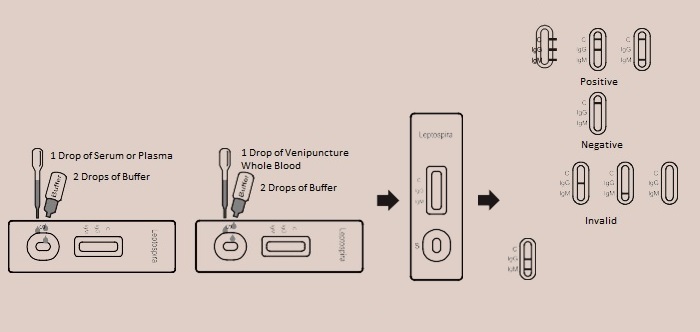 INTERPRETATION OF RESULTS IgG POSITIVE: Two distinct coloured lines appear. One coloured line should be in the control region (C) and another coloured line should be in the IgG region. IgM POSITIVE: Two distinct coloured lines appear. One coloured line should be in the control region (C) and another coloured line should be in the IgM region. IgG and IgM POSITIVE: Three distinct coloured lines appear. One coloured line should be in the control region (C) and another two coloured lines should be in the IgG and IgM regions. NOTE: The intensity of the coluor in the IgG and IgM region(s) will vary depending on the concentration of Leptospira antibodies present in the specimen. Therefore, any shade of red in the IgG and IgM region(s) should be considered positive. NEGATIVE: One coloured line appears in the control region (C). No apparent red or pink line appears in the IgG and IgM region(s). INVALID: Control line fails to appear. Insufficient specimen volume or incorrect procedural techniques are the most likely reasons for control line failure. Review the procedure and repeat the test with a new test cassette. If the problem persists, discontinue using the test kit immediately and contact your local distributor. QUALITY CONTROL Internal procedural controls are included in the test. A coloured line appearing in the control region (C) is an internal positive procedural control. It confirms sufficient specimen volume and correct procedural technique. Control standards are not supplied with this kit; however, it is recommended that positive and negative controls be tested as a good laboratory practice to confirm the test procedure and to verify proper test performance. LIMITATIONS 1. |
The Direction for Use and the Interpretation of Result must be
closely when testing the presence of antibodies to pathogenic L.interrogans in serum, plasma or whole blood from individual subjects.
Failure to follow the procedure may give inaccurate results. |
2. |
The Leptospira IgG/IgM Rapid Test Cassette (Whole Blood/Serum/Plasma)
is limited to the qualitative detection of antibodies to Leptospira interrogans in human serum, plasma or whole blood. The intensity of the test
band does not have linear correlation with antibody titer in the specimen. |
3. |
A negative result for an individual subject indicates absence of
detectable Leptospira interrogans antibodies. However, a negative test result does not preclude the possibility of exposure to Leptospira
interrogans. |
4. |
A negative result can occur if the quantity of Leptospira
interrogans antibodies present in the specimen is below the detection limits of the assay, or the antibodies that are detected are not
present during the stage of disease in which a sample is collected. |
5. |
Some specimens containing unusually high titer of heterophile
antibodies or rheumatoid factor may affect expected results. |
6. |
The results obtained with this test should only be interpreted
in conjunction with other diagnostic procedures and clinical findings. |
EXPECTED VALUES he Leptospira IgG/IgM Rapid Test Cassette (Whole Blood/Serum/Plasma) has been compared with a leading commercial Leptospira IgG ELISA, Leptospira IgM ELISA test. The correlation between these two systems is over 98%. PERFORMANCE CHARACTERISTICS  Relative Sensitivity: 90.0% (95%CI*: 55.5%-99.7%) *Confidence Intervals Relative Specificity: 98.6% (95%CI*: 96.1%-99.7%) Accuracy: 98.3% (95%CI*: 94.7%-98.9%) A total of 239 samples from susceptible subjects were tested by the Leptospira IgG/IgM Rapid Test Cassette and by a commercial Leptospira IgG ELISA kit. Comparison for all subjects is shown in the following table.  Relative Sensitivity: 93.8% (95%CI*: 69.8%-99.8%) *Confidence Intervals Relative Specificity: 98.7% (95%CI*: 96.1%-99.7%) Accuracy: 98.3% (95%CI*: 95.8%-99.5%) Intra-Assay | |||||||||||||||||||||||||
| Acetaminophen: 20 mg/dL Acetylsalicylic Acid: 20 mg/dL Ascorbic Acid: 2g/dL Creatin: 200 mg/dL Bilirubin: 1g/dL |
Caffeine: 20 mg/dL Gentisic Acid: 20 mg/dL Albumin: 2 g/dL Hemoglobin: 1000mg/dL Oxalic Acid: 60mg/dL |
| None of the substances at the concentration
tested interfered in the assay. |
|
| 1. | Stallman GND. The International Committee on Systematic Bacteriology: Sub committee on the Taxonomy of Leptospira. Int J Syst Bacteriol 1987; 37:472. |
| 2. | Levett PN. Leptospirosis. Clin Microbiol Rev 2001;14:296-326 |
| 3. | Faine S, ed. Guidelines for the control of leptospirasis. Geneva: World Health Organization, 1982. |
| 4. | Cumberland PC, Everard COR, Levett PN. Assessment of the efficacy of the IgM enzyme-linked immunosorbent assay (ELISA) and microscopic agglutination test (MAT) in the diagnosis of acute leptospirosis. Am J Trop Med Hyg. 1999; 61: 731-734. |
| 5. | Adler B, Murphy AM, Locarnini SA, Faine S. Detection of specific anti-leptospiral immunoglobulins M and G in human serum by solid-phase enzyme-linked immunosorbent assay. J Clin Microbiol. 1980; 11: 452-457. |
| 6. | Appassakij H, Silpapojakul K, Wansit R, et al: Evaluation of the immunofluorescent antibody test for the diagnosis of human leptospirosis. Am J Trop Med Hyg 1995; 52: 340. |
 |
|
 |
ICT INTERNATIONAL 271 De Goede Hoop Est Noordhoek Cape Town South Africa www.ictdiagnostics.co.za +27 82 441 1922 email: russell@ictdiagnostics.co.za |
| Effective date: 2019-01-18 |
|